Dark Airbnb Photos Make Good Spaces Look Cheap
The place is bright in real life. Why does it look dull online?
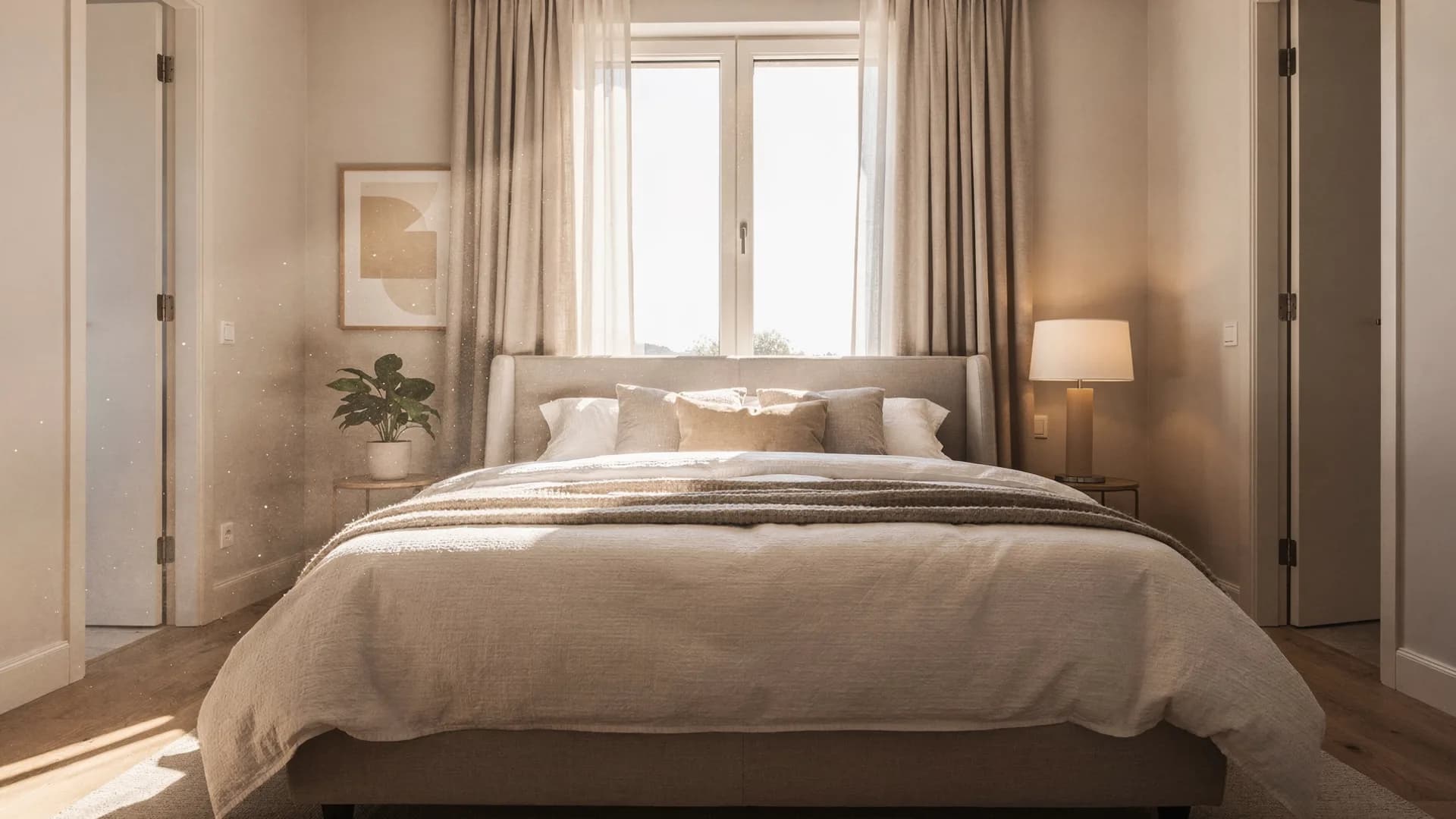
A dark photo does not just look dark. It makes the room look colder, older, smaller, and cheaper than it probably is. You've felt this without having words for it: you open your own listing, land on the kitchen photo, and something in your chest tightens slightly — the room you scrubbed for two hours looks vaguely grubby, vaguely gray, vaguely like a place someone would describe as "fine." You know it isn't. You've stood in that kitchen at 9am when the light comes through the window and it looks like a reason to book. But that's not the kitchen you published.
Here's a small demonstration of what you're up against. Put the same white ceramic mug on two different countertops, photograph both at 6pm with the overhead light on, and something strange happens: one mug looks crisp and clean, the other looks slightly grey, slightly tired, like it's been sitting there since a previous decade. Nothing about the mug changed. The light changed. Guests read that difference as a judgment about the home, not the lighting, because they have no way to separate the two — and no interest in trying at scrolling speed.
This is the Darkness Tax, and it's collected on otherwise excellent properties every single day. Darkness doesn't just make a photo dimmer. It borrows a whole set of negative associations — old, cold, cramped, under-maintained — and pins them onto a space that may be none of those things in person. The quietly humiliating part is that guests then blame the property, and hosts then blame themselves, and the actual culprit was a lightbulb and a time of day. If your listing has ever made you feel like your home is cheaper than you know it is, keep reading, because this is the most reversible problem in listing photography — usually for free.
Why Guests Read Darkness as Quality, Not Lighting
Nobody consciously thinks "this photo has poor light temperature." What they think, in the half-second a thumbnail gets, is closer to a vague unease: something about this place feels off. That unease gets attached to the property itself — the age of the fixtures, the cleanliness, the value for the price — because guests have no framework for separating a lighting choice from the thing being lit. A dim photo of a spotless apartment reads as a dim, faintly suspect apartment. The cleanliness doesn't get credit it earned, because the photo never showed it clearly.
The Price Comparison Guests Make Without Realizing It
Darkness doesn't just cost trust, it costs perceived value at a specific price point. A guest comparing two listings at $140 a night, one shot in warm natural light and one shot dim and yellow-cast under a kitchen bulb, will very often describe the darker one as "overpriced for what it is," even when the underlying property is equal or better. They're not doing a conscious calculation. They're pattern-matching darkness to age and neglect, the same way a dimly lit used car lot reads as sketchier than a brightly lit one, regardless of what's actually parked there.
This is a particularly expensive mistake because it compounds with pricing decisions hosts make separately. A host with dark photos who also notices soft bookings will often reach for a price cut, assuming the market has cooled, when the actual fix was sitting in the photo gallery the entire time, unrelated to price at all. Two problems get treated as one, and only one of them ever gets solved.
Overhead lighting is the most common culprit, and it's almost always well-intentioned — a host turns on every light in the room before shooting, assuming more light equals a brighter photo. In practice, overhead bulbs cast light downward and create shadow under counters, cabinets, and furniture edges, which reads as grime even in a freshly cleaned space. The room isn't dirty. The lighting is just casting shadows in exactly the places that make dirt visible if it were there.
The Same Room, Two Very Different First Impressions
It's worth actually seeing this side by side once, because the difference tends to be more dramatic than hosts expect from something as simple as timing. A kitchen shot under overhead fluorescent light at 8pm and the same kitchen shot in morning light with the overheads off can look like two different rooms — different wall color, different sense of size, different apparent age of the cabinetry. Nothing physical changed between the two photos except when and how they were taken, yet a guest comparing listings would reasonably conclude they were looking at two different properties in two different price tiers.
What Actually Fixes It
The fix is almost never more effort. It's different timing and different light sources. Natural light from windows, especially in the two hours after sunrise or before sunset, is more flattering than any overhead fixture a host can install, and it's free. Shooting with curtains open and overhead lights off, angled so the window light falls across the room rather than behind the camera, resolves most of what reads as darkness in typical listing photos.
This connects directly to the broader idea in Your Airbnb May Not Be Broken — that a property penalized by its own photos isn't a property with a real flaw, it's a property whose documentation hasn't caught up to what's actually there. Lighting is one of the fastest, cheapest versions of that gap to close.
A Lighting Pass Before Your Next Shoot
Fix the light before you touch anything else
- Shoot during the two hours after sunrise or before sunset whenever the room has any natural window access.
- Turn off overhead lights during the shoot and rely on window light plus one soft lamp if needed, rather than every bulb in the room.
- Open all curtains and blinds fully, even ones you'd normally keep partly closed for privacy during the actual stay.
- Check for warm-versus-cool bulb mismatches across rooms — inconsistent color temperature reads as neglect even in a clean space.
- Review your existing gallery specifically for any photo taken after dark or under flat overhead light, and flag those first for reshoots.
- Compare a reshot photo directly against the original at thumbnail size before uploading, to confirm the difference actually holds up at search scale.
Light is the cheapest renovation your listing will ever get.
Checking Your Work Honestly
Once you've reshot a room, resist the urge to judge the new photo against the old one on your laptop, in full brightness, sitting close to the screen — that's the most flattering possible viewing condition and it will make almost any improvement look bigger than it actually is at search size. Judge it the way a guest will encounter it: small, on a phone, in a grid next to a dozen competitors, for less than a second before they move on or don't.
A Small Investment, If You Want One
For hosts who want to go slightly further than free, a single warm-white bulb swap in the room's existing fixtures — matching color temperature across the space — closes most of the remaining gap for under twenty dollars. A cheap bounce card, even a piece of white foam board propped opposite a window, softens harsh shadow without adding a single new fixture. Neither requires a photographer or a renovation budget. Both address the actual mechanism behind the darkness tax rather than papering over it with heavier editing after the fact.
None of this requires new furniture, a repaint, or a professional photographer, though any of those help. It requires shooting the home you already have at the time of day it actually looks like itself. Guests aren't judging your fixtures. They're judging what the fixtures look like at 2pm under a bulb that was never going to flatter them.
Published May 27, 2026 / 6 min
Related Reading
The First Five Photos Rule Every Host Should Obsess Over
Your 27th photo can't rescue a weak first impression.
June 3, 2026
6 min
Your Cover Photo Is Either Winning the Click or Killing It
Guests don't reject your whole property first. They reject a thumbnail.
June 6, 2026
6 min
Professional Photos vs Honest Photos
Better photos should create desire and protect trust at the same time.
May 23, 2026
6 min